
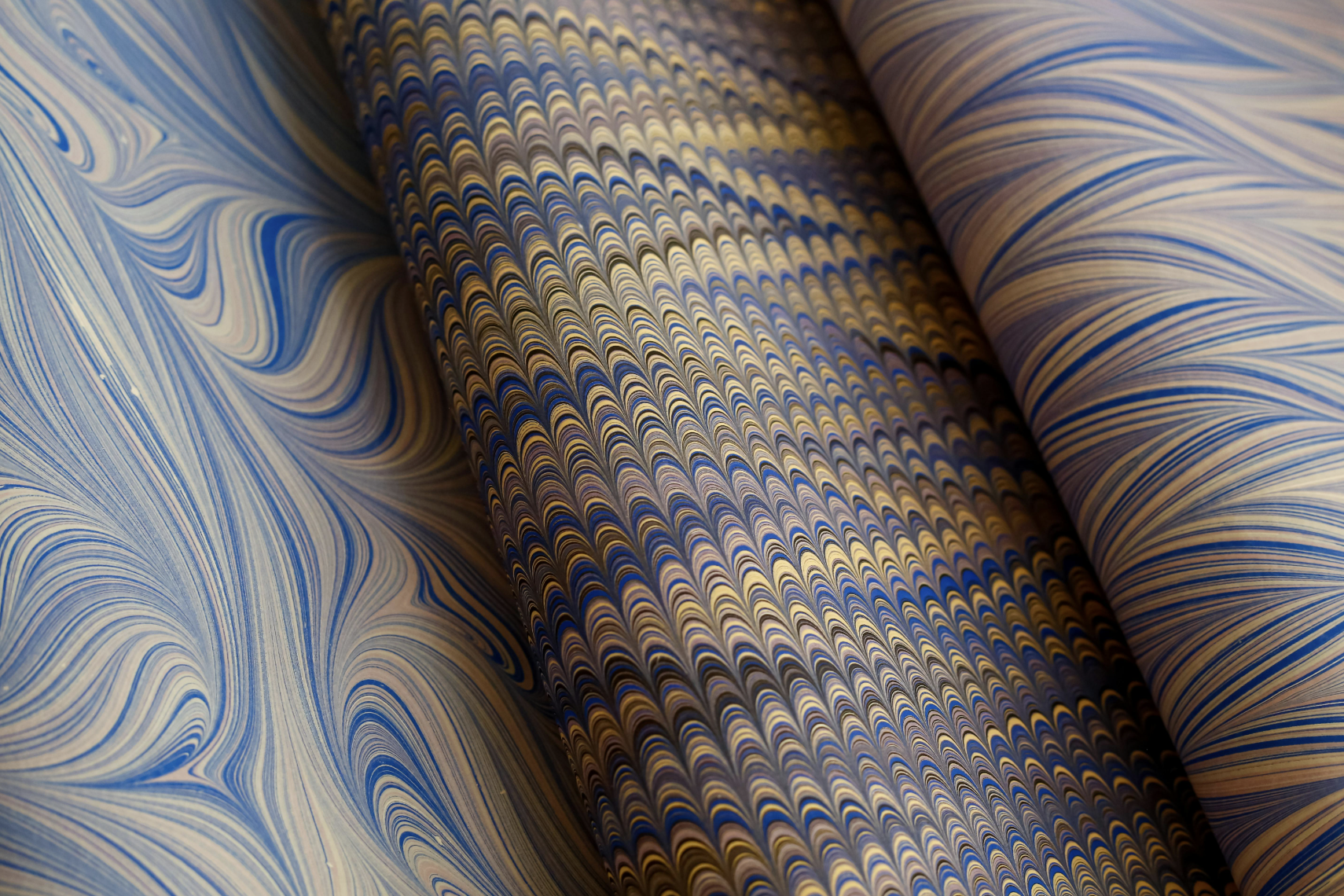
Few traditional surface-decoration techniques are as visually striking or historically rich as paper marbling. For centuries, marbled paper has been prized for its intricate, fluid patterns — used in everything from book covers and stationery to luxury packaging and contemporary art. Today, marbling remains a favorite among paper lovers, printers, and designers, not just for its beauty, but for its tactile connection to craft traditions around the world.
Let’s explore the fascinating history of paper marbling, how it traveled across continents, and the varied techniques that continue to inspire creative professionals, while celebrating some of our favorite Design & Paper DIY marbling tutorials from the past, so you can bring this technique with a rich heritage into your own design process.

From Floating Ink to Decorative Mastery
The earliest known marbling traditions can be traced back to East Asia, where artisans first discovered the expressive possibilities of ink floating on water. During China’s Tang Dynasty, experiments with ink and surface tension laid the groundwork for what would later develop into structured marbling techniques. The practice matured in Japan between the 12th and 16th centuries into what is now known as suminagashi, meaning “floating ink.” In this delicate process, sumi ink is gently dropped onto the surface of clear water, where it expands into soft concentric rings. Without heavy manipulation, the artist captures these organic formations by carefully laying paper onto the water’s surface. The results are ethereal, subtle, and deeply meditative — quite distinct from the bold marbling styles that would later emerge elsewhere.
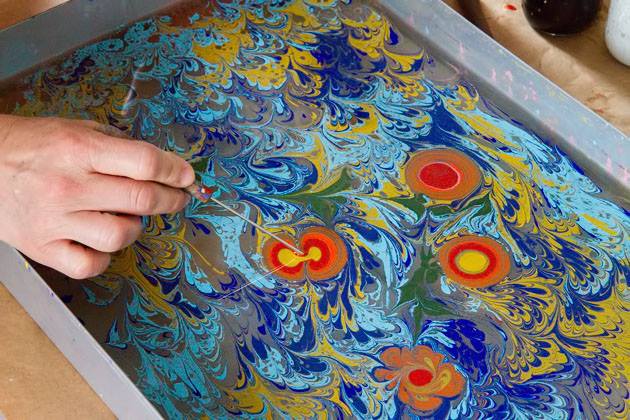
From East Asia, marbling techniques traveled west along trade routes, evolving significantly as they moved through Persia and into the Ottoman Empire. By the 15th century, the craft had become highly refined in Turkey under the name Ebru, often referred to as Turkish marbling. Here, artists developed more controlled and decorative approaches by thickening the water bath with natural gums to suspend pigments more effectively. Using styluses, combs, and brushes, they manipulated the floating colors into intricate stone-like veins, feathered repeats, and even stylized floral motifs. Marbled papers were used in manuscripts, calligraphy panels, and official documents, valued not only for their beauty but also for their symbolic and cultural significance. Ebru remains an important artistic tradition today, recognized for its expressive precision and technical sophistication.
By the 17th century, marbled paper had entered Europe, where it quickly gained popularity among bookbinders and printers. European craftsmen initially drew inspiration from Ottoman examples but soon developed their own distinctive patterns and palettes. In Italy, France, Germany, and later England, marbling became closely associated with fine book production. It was widely used for endpapers, covers, and document linings, adding both protection and ornamentation to bound works. During the 18th and 19th centuries, the craft became increasingly systematized, and many of the patterns still recognized today — such as nonpareil, peacock, and Spanish wave — were formalized during this period. Marbling workshops operated as specialized studios, supplying the growing publishing and printing industries with decorative sheets that balanced repeatability with handcrafted uniqueness.
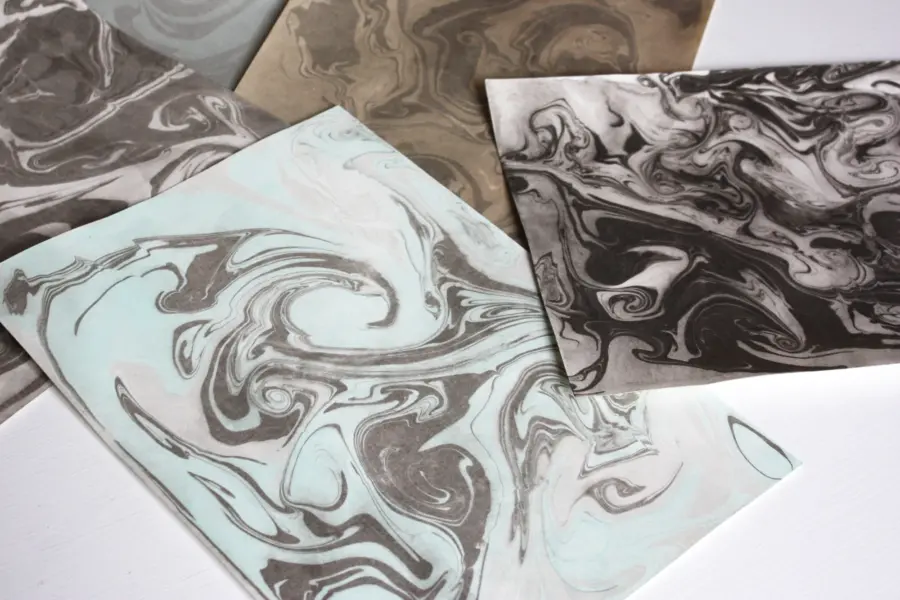
Although regional variations differ, the core principle of marbling has remained consistent across centuries: pigment floats on a prepared liquid surface, is manipulated into patterns, and is then transferred to paper in a single, decisive print.
In Japanese suminagashi, the process remains minimalist and organic, often requiring little more than ink, water, and absorbent paper. The absence of heavy manipulation allows the water itself to act as collaborator, producing naturally flowing rings and subtle tonal shifts. In contrast, Turkish Ebru and later Western marbling techniques rely on a thickened bath, traditionally made from natural sizing agents, which stabilizes the pigments and allows for more deliberate pattern construction. Tools are used to draw through the floating colors to create repeating motifs with fine detailing. Western marbling in particular developed a vocabulary of structured patterns that could be reproduced with relative consistency, making it especially suitable for commercial bookbinding.
For paper professionals, these distinctions are more than aesthetic. They reveal how fiber composition, absorbency, coating, and surface treatment influence pigment transfer. Marbling is, at its core, an interaction between liquid behavior and paper structure — a dialogue between surface tension and cellulose.
Despite its centuries-old origins, marbling remains remarkably relevant in modern paper practice as it’s unpredictability offers a refreshing counterpoint to digital precision.
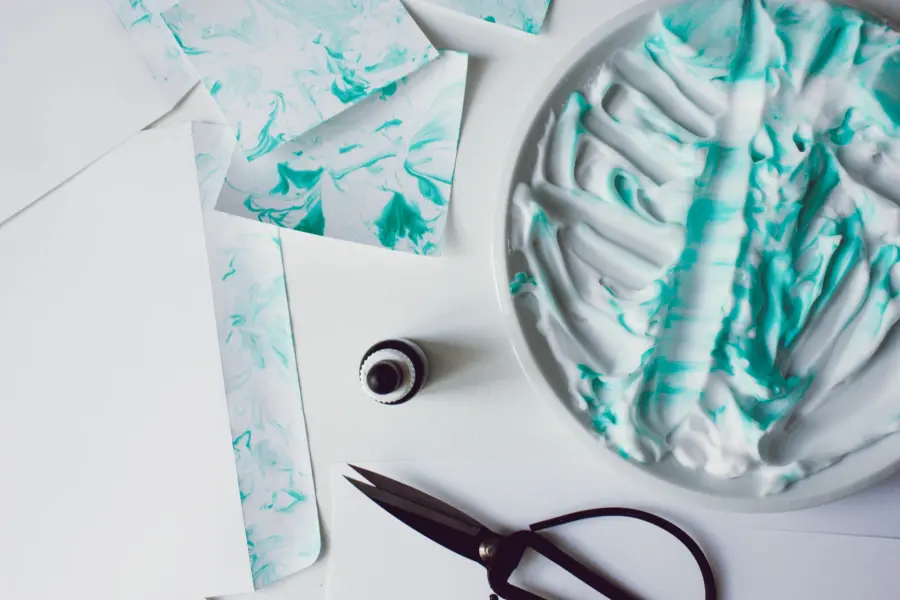
From bespoke stationery and limited-edition publications to home crafts and art prints, marbling continues to inspire creative exploration. In the past, we at Design & Paper have also explored a few approachable interpretations of the marling technique. The Paper Marbling with Shaving Cream & Ink DIY tutorial demonstrates how a household classic such as shaving cream can produce dramatic, accessible results while maintaining the spirit of traditional marbling. In the DIY Marbling article, we experiment with the traditional floating pigments and pattern manipulation technique of marbling. And for a playful seasonal adaptation, our DIY Marbled Easter Eggs feature shows how marbling principles can be applied beyond paper — a reminder that the technique is as versatile as it is beautiful.
Beyond the classic examples of marbling being utilized in paper, printing, and book production, marbling is a living example of how material experimentation shapes visual culture. It teaches us about absorption, layering, timing, and touch, elements that remain just as relevant in contemporary print production as they were centuries ago. Most importantly, marbling reminds us that paper is never just a passive surface. It is an active participant in the creative process. Each sheet captures a singular moment when pigment, water, and fiber meet — making every print inherently unique. In an era of mass reproduction, that uniqueness feels more valuable than ever.